by Meghan Byrne, Communications and Engagement Lead

New Data, Better Decisions

Reducing embodied carbon starts long before a project reaches construction. It begins with shared data — common reference points that help project teams work from the same numbers and make informed decisions with confidence. As the industry shifts from asking whether embodied carbon matters to how to reduce it, those reference points need to evolve alongside the market.

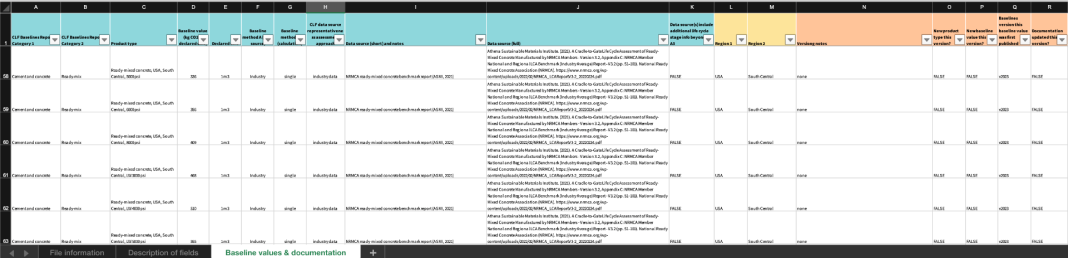
This month, we're excited to release the 2026 CLF North American Material Baselines, the latest update to one of CLF's most widely used resources. The new edition reflects the latest available data, helping practitioners benchmark projects, set meaningful targets, and make more informed material decisions.

Resources like the CLF North American Material Baselines have the greatest impact when they're put into practice. This month, we invite you to apply the updated baselines to one decision you're already making — whether that's reviewing a material specification, refining a procurement requirement, or preparing for a client conversation. Share the resource with a colleague, bring it to your next project meeting, or take a few minutes to explore what's new.

Data is only valuable when it's put to work. Thank you for being part of the CLF community and for helping turn better data into better decisions.

2026 CLF North American Material Baselines — An Updated Set of Baseline Values

The 2026 CLF North American Material Baselines project continues the work of previous CLF Material Baselines reports and datasets. Like previous versions, the v2026 dataset aims to support decision-makers by providing an updated set of CLF baseline GWP values. These “CLF baselines” represent an estimate of industry-average GHG emissions for construction materials manufactured in North America. Their primary uses are:

  • a basis of comparison; a reference point against which individual products can be evaluated; and 
  • default GWP intensity values for project- or assembly-scale modeling.

This new 2026 version:

  • adds and updates baseline values to reflect the latest published industry-wide data, with new values for dozens of product types across several categories, including brick, steel, wood, insulation, cladding and roofing, and flooring.
  • follows the same methods documented in the v2025 report.
  • is a downloadable spreadsheet file only (not a PDF report).
  • does NOT include an updated “state of EPDs” snapshot or reflect new manufacturer EPD data. (For v2026, CLF focused on updating baselines based on new industry-average EPDs. We intend to continue to provide those bigger updates on odd-year publications, as we have in the past.) 
Explore the 2026 CLF Material Baselines updates

Labs2Zero: A Path to Decarbonize and Improve Research Facilities

By Dirk von Below and Gordon Sharp, International Institute for Sustainable Laboratories (I2SL)

Recognizing that laboratories use five to 10 times as much energy as office buildings, the International Institute for Sustainable Laboratories (I2SL) created Labs2Zero to help reduce energy, costs, and emissions in the world’s research facilities. The program offers a variety of free building performance assessment and improvement tools to help lab owners, managers, designers, and engineers better understand and address their energy use and emissions. Labs2Zero tools are the first of their kind to benchmark and rate lab building performance.

Read more
Welcome to CLF, Frances!

Frances Yang is Associate Director of Low Carbon Design, with the role of supporting research, strategy, and coordinated action for CLF to reduce embodied carbon emissions globally. 

Learn more about Frances

New C40 resource “Circular construction and material reuse handbook for cities” to support city teams working to establish an equitable and economically viable circular value chain.

MassCEC RFP Now Open: MASS Timber Assembly for Massachusetts Projects (Apply by August 28).

“ASCE/SEI Prestandard for Assessing the Embodied Carbon of Structural Systems for Buildings” recommends scope and a calculation methodology for assessing the embodied carbon emissions of structural systems.

Mission Possible Project report “Building clean industry: a route to resilience in a volatile world” and Global Tracker highlight clean industry progress.

USGBC article highlights how one school district used CLF Material Baselines to prioritize embodied carbon reductions in the design of new schools.

Connect with the newest CLF Regional Hub!

The CLF Québec Regional Hub brings together professionals from across Québec’s built environment sector — including architects, engineers, contractors, material manufacturers, owners, developers, sustainability consultants, researchers, and public-sector representatives — to learn, connect, and collaborate on reducing carbon emissions in construction. The hub promotes the reduction of embodied carbon associated with building materials and supports sector-wide transformation through education, knowledge sharing, and collaborative action.

Check it out and follow them on LinkedIn to stay connected!
What resources help you move your work forward?
As CLF continues to develop new tools, research, and resources to support building decarbonization, we want to better understand what information is most useful to the professionals, policymakers, advocates, and organizations we serve.
 

This short survey (5-10 minutes) will help us identify the types of resources, formats, and topics that are most valuable across different industries and roles. Your feedback will help inform future CLF publications, tools, trainings, and communications efforts.

Complete the survey by Friday, July 31st
How to Get Involved

Join a growing movement of researchers, policymakers, practitioners, and advocates working to decarbonize the building sector.

Ways to participate:

  • Join the CLF Network – Connect with 10,000+ professionals worldwide

  • Participate in regional CLF hubs

  • Share or submit resources and case studies

  • Attend CLF-hosted events and webinars

  • Advocate for embodied carbon policies in your state

Your voice strengthens the community and accelerates progress.

Visit CLF Website

About the Carbon Leadership Forum

Who We Are

  • The Carbon Leadership Forum accelerates transformation of the building sector to radically reduce the embodied carbon in building materials and construction.
  • We pioneer research, create resources, foster cross-sector collaboration, and incubate member-led initiatives to bring embodied carbon emissions of buildings down to zero.
  • We are architects, engineers, contractors, material suppliers, building owners, and policymakers who care about the future and take bold steps to eliminate embodied carbon from buildings and infrastructure.

www.carbonleadershipforum.org

© Copyright 2026

Carbon Leadership Forum

4100 Redwood Rd #20A
Oakland, CA 94619-5726
United States


You received this message because you subscribed to receive mailings from us, are a member of one of our groups, or have requested information.

Update Your Contact Information | Unsubscribe | Forward | Contact us: [email protected]